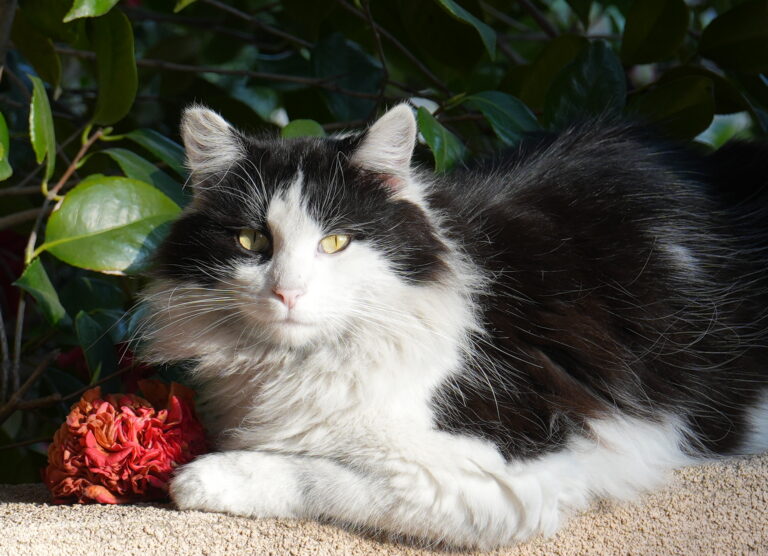
“The breeding of pet cats is the root problem and the number one priority.” Monica Barker has twenty-seven years’ experience with TNR programs. ed.
When I asked Monica Barker whether she’s seen an increase in illness and injuries in the local feral cat population, she replied,
“Goodness yes! Cat Network is paying for emergency amputations, eye removals and massive wound care every single month.”
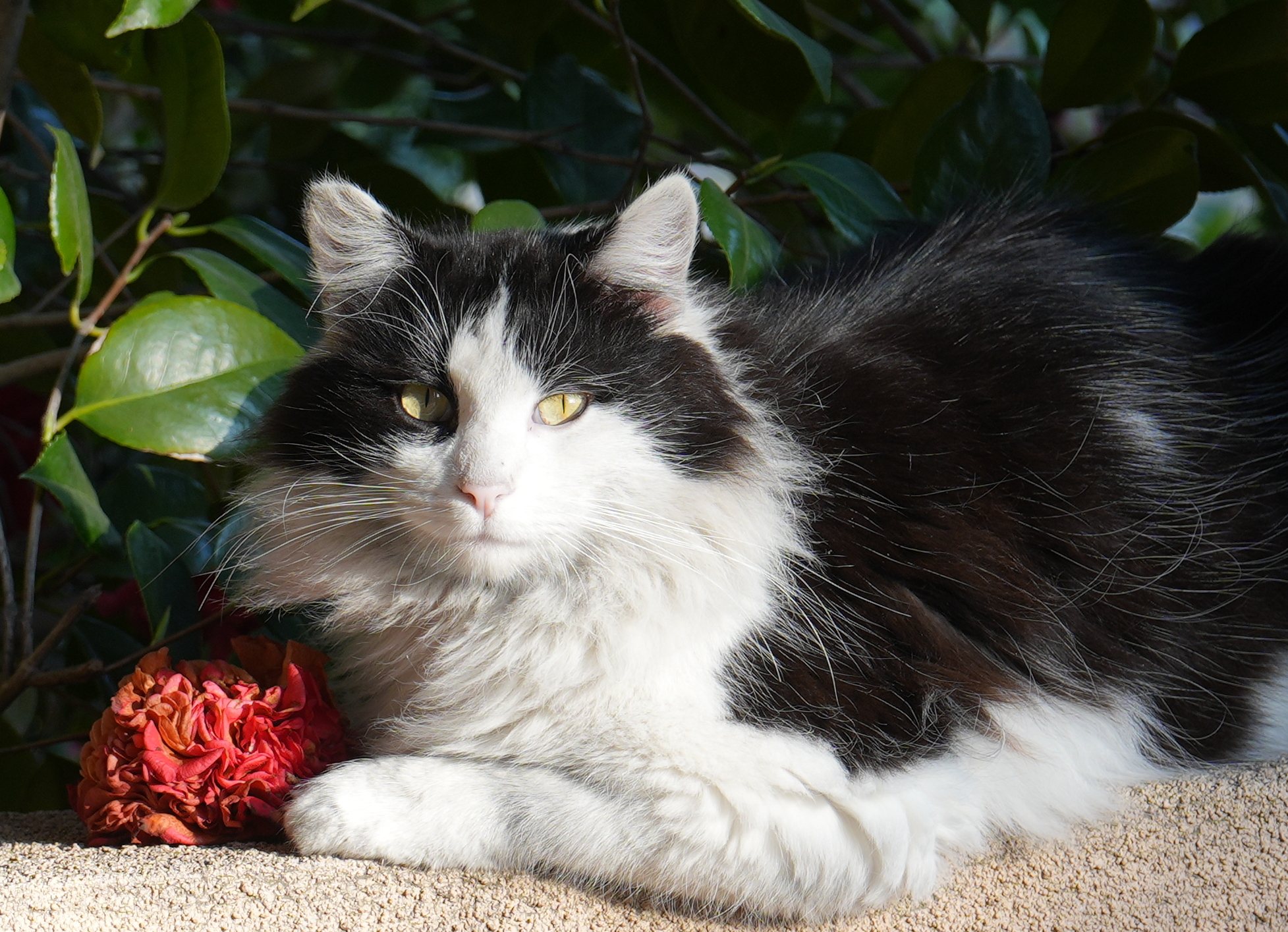
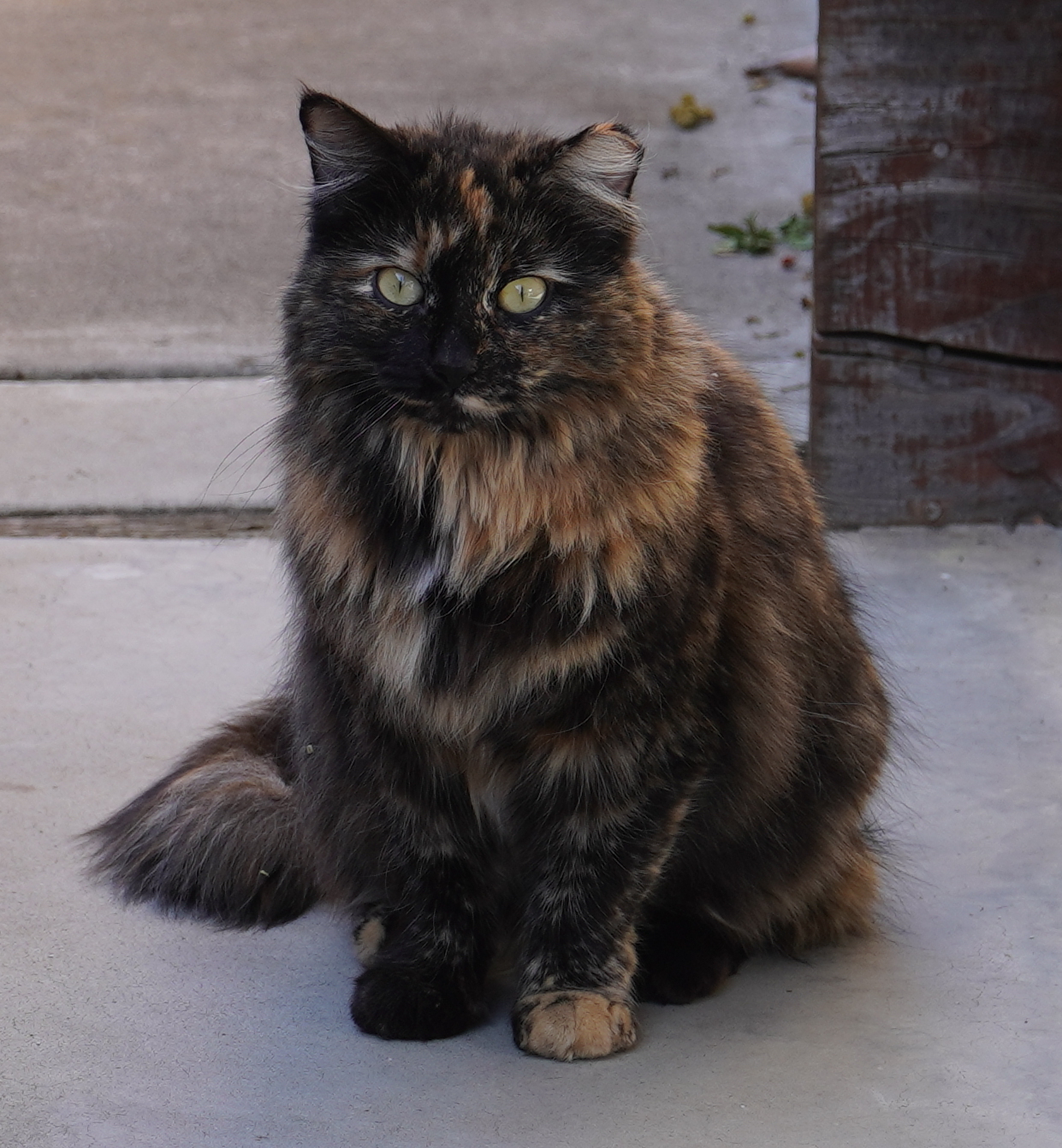
I had planned to publish some photos of the injured cats, but when Monica sent pictures, I couldn’t bear looking. Images of animal suffering wound the heart too deeply. I put up a couple of photos of fixed neighborhood ferals instead.
Cat Network of Stanislaus is Monica Barker’s labor of love for the “wild” animals that became part of our lives over 10,000 years ago, when the advent of agriculture brought about a rise in the prey species and food scraps cats thrive on. Like dogs, cats proceeded to help form our closest bonds to some of nature’s most able ambassadors.
Though they are predators themselves, cats often suffer high mortality, both in natural and urban environments. The evolutionary remedy for high mortality among animals is reproduction — cats can reproduce at four months old and often have litters of six kittens or more.
Most often, only people with surplus wealth and boundless affection can board and afford multiple cats — Ernest Hemingway was said to have “owned” more than twenty when he lived at Key West. The predictable outcome from high reproduction and unmatched homing is feral cat populations.
In good times, subsidized spay and neuter services are the chief factor in controlling feral cat populations and reducing the suffering feral cats endure from inevitable encounters with automobiles, depraved people, hostile dogs and other urban perils. As is the case with many areas of our economy, times have been tough for animal services since the pandemic.
“We have endured at least 6 years of a severe shortage of spay and neuter appointments due to the changes the pandemic created,” said Barker during an email interview.
Despite drastic reductions in government services and subsidies, Cat Network, funded solely by grants and donations, assists 25-50 feral cats every week of the year. Seven regular volunteers join Monica in a Trap, Spay and Neuter (TNR) program that is widely accepted as the most cost-effective and humane way to manage feral cat populations. Despite these efforts, feral cat populations in Modesto and Stanislaus County have burgeoned and feline suffering has reached cruel proportions.
Recently, Stanislaus Animal Services Agency (SASA) has become a focal point for controversy because of inadequate services, rising euthanasia rates, and related issues. A new director was appointed earlier this month.
After twenty-seven years on-the-ground experience with local feral cat populations, Monica Barker says there are three imperatives for managing them:
- “Work on increasing pet cat spay/neuter services, either through the Love Clinic or by contracting with local vets using vouchers. The breeding of pet cats is the root of the problem and the number one priority.
- Open vaccine and microchip clinics. We need to open low-cost options to the general population…hospitals and mobile vaccine clinics are not low cost at this time.
- Offer same-day TNR…It reduces costs and the risks of animals spreading disease among themselves.”
Barker adds that,
“A good TNR program is more than just access to free or low-cost spay and neuter. It needs to include education and training on cat colony management and access to reliable trap equipment.”
Animal lovers who feed “stray” and “alley” cats should be especially concerned those cats are fixed and vaccinated. Many cat-loving neighborhoods enjoy visitations from their feral friends and share the costs of keeping the local population manageable through TNR. The joy of their presence is reward enough.
With new management and increased community awareness and concern, the Stanislaus Animal Services Agency may be ready to move forward toward increased efficiency and reduced suffering for our feline friends and neighbors. A wise first step would be to listen to and support Cat Network*, where cost-effective and humane management practices have been sharpened by years of on-the-ground experience and success. Monica Barker and her volunteers are in the top tier of local experts on domestic and feral cat management.
*Cat Network has a small population of thoroughly domesticated and trained rescue cats, available for a small fee to cover vaccinations, neutering, and chips. Check here if interested. They do not accept cats from the public.
There are certainly cat-loving individuals, but I don’t think there are cat-loving neighborhoods.
People who feed cats should be responsible for them. The suffering and death—usually under cars, but also starvation when the individuals move and leave cats behind, not to mention cats injured fighting, elderly cats, cats with various diseases—is unconscionable.
My neighborhood is enduring a major resurgence in the cat population after many years of normal numbers due to a couple of misguided people.
Thank you CL. Perhaps the “resurgence” is because of the countywide failure to follow TNR as recommended by Cat Network. As Monica said, there is a “resurgence” throughout the county; surely that countywide increase in the feral cat population isn’t due to “a couple of misguided people.” Many of us will attest to “cat-loving neighborhoods” because we live in them. However, it is critical to keep the feral population down with TNR. We do agree that people who feed cats should be responsible for TNR. “Normal numbers” should be low and manageable.
Many people are trying to get their pets and colony cats spayed and neutered. The biggest obstacles are timely appointment availability whether through vet clinics or the county. Clinics are so backed up with appointments that it can take weeks or longer to get your pet in. In the meantime, pets can become pregnant again , particularly cats. The county appointments are abysmally few. Private clinic cost are prohibitive, pushing many to forego the procedure or resort to seeking donations via social media to help defray costs,
As a cat owner myself, I can attest to the skyrocketing vet. bills . Food bills are skyrocketing too. It really is shocking and it’s no wonder to me why so many pets, particularly cats get abandoned. And soon to become an issue are the abandoned dogs. Large breed dogs in oarticluar because of their food needs , not to mention that spay and neutering of a large breed dog is much more expensive than a cat.
High costs and lack of affordable, timely spay/ neuter is the root cause of this crisis . Compounding this are tone deaf city councils and county board of supervisors who clearly aren’t interested in this crisis.
And there are more people moving to the valley and they bring pets with them and many of those will become abandoned as well. The problem compounds daily . There is a widespread mindset that volunteers will take care of these cats and incessant complaints when the problem doesn’t go away, and just gets worse.
Regular consistent TNR with government subsidy will reduce the numbers and be humane. Refusing to subsidize TNR will only add to taxpayer expense down the road with increased feline diseases, animal control calls and impounding and sadly, euthanasia for most. Recall the old time saying, “ an ounce of prevention is worth a pound of cure” .
And remember, many of those who are deemed “ feral” are not. They are someone’s pet that was dumped, left behind when their owners moved or because some cruel, sick people deliberately trap them and dump them out in a rural area. These cats can’t fend for themselves . A true feral is one born and raised entirely without human contact. Either way, WE have created this crisis .
There is one thing that is not mentioned in your excellent article and that is the detrimental impact that the over population of cats has on our songbird populations.
Along with loss of habitat and the construction and night lighting of multi story buildings the domestic cat population owns the main reason for the catastrophic loss of the many different song birds that enrich our lives and plays such an important part in the balance in Mother Nature.
Spay and neuter the cats in your neighborhood now.
That was poor journalism that didn’t give a fair and unbiased assessment of the feral cat problem. There are plenty of ecologist and wildlife biologist willing to share their expert opinion on the problem feral cats cause to wildlife. It didn’t address the cat food, plates, bowls, boxes and blankets left in our parks users and staff have to deal with. It didn’t address the enormous costs of spaying and neutering thousands of feral cats and where those funds will come from. Maybe this was an opinion piece and I mistook it as a journalistic article.
Thank you Michael. The issues you raise are important. Perhaps we can begin with the existence of animal control agencies in the first place. What are these agencies’ missions? Why do we fund them? Funding for any government agencies come from tax dollars. Have those tax dollars been used effectively in Stanislaus County? You seem to be making a distinction between cats and “wildlife.” Cats are wildlife.
The cats are an introduced species that have become invasive and they are certainly not wildlife if they are living in colonies, being fed by humans and killed by diseases and raccoons. I do interact with cats the public doesn’t see that perhaps could be considered wild.I only work in wildlife and out of respect for my highly educated superiors I try to stick with labor and let them communicate with journalists. We have a River Partners office on G Street in Modesto. Their exologists give excellent interviews. We have a biologist working on the Seventh Street Bridge who is an expert on stray/feral cat problem. Last month a Bay Area parks manager held an online symposium on how the cats are devastating the shore birds on the coast. You can also contact CA F&W for a statement. I as a laborer, deal with the consequences on feeding cats in the parks when foxes, raccoons, opossums and other actual wildlife become dependant on cat food. This leads to wildlife exchanging disease with the stray/feral cats and in extreme cases can lead to euthanasia of wildlife when those animals turn aggressive towards humans. I do appreciate your articles about Larry Byrd and water conservation in general. I think in this case, you could do a better article. Thank you very much for being polite and responsive to criticism.
Thank you Mr. Hart. We always appreciate expert opinion. I agree feral (wild) cat populations are too large. Some places have opted to exterminate cats. Many of us believe that’s an inhumane option. The only viable alternative I’m aware of is to manage feral populations at the lowest possible levels with TNR programs. River Partners is one of our greatest public assets and I wish they had twenty times more resources. As far as “a better article,” I encourage you to submit one. I’m not aware of alternatives to TNR other than mass euthanasia. Again, what is the mission of animal control agencies? I very much appreciate your informed comment. However, unless I missed it, you offer no alternatives to TNR. By the way, I’m an experienced birder and very aware of cat predation on birds. Again, we need viable and humane management options. I might add that I believe our local animal control agency has been mismanaged and has squandered funds. For evidence, I offer the inarguable fact of bureoning feral cat populations. I also believe we need an intensive educational effort so that people accept the responsibility for neutering their cats. Given today’s high costs, it makes sense to reduce costs as part of animal control services. As you likely know, the Larry Byrd investigation is ongoing and will continue until justice is served. I appreciate your interest and thank you.
I do see euthanasia as the only realistic option as the cat problem is widespread. It is also a stray/feral dog problem that is far too widespread. I will also say my opinion is that the primary duty of animal control is the health and safety of humans, not the animals. The second duty is ensuring the humane treatment of domestic animals. F&W is responsible for wildlife. I do not write articles as I do not have that talent but I appreciate you beleiving in me. I do mostly physical labor. I have assisted Kathleen Quinn on four articles for The Bee and I love doing that. I think I do that well and I should probably stay in my lane. When I helped Kathleen, I was adamant that she include the perspective of landowners in regards to our beavers. I love having beavers in Modesto but some landowners have a different opinion that is also valid. If you would like a driving tour of places in our area that have a concentrated cat problem I would be happy to do that and I can help put you in contact with educated wildlife management people.
Thank you Mr. Hart. We differ on euthanasia, as I suspected. I’ll try to find time to get together with you. I believe we can live with nature, including plant and animal life, with much less unnecessary mortality. I value the natural intelligence of animals just as I value our own natural intelligence. I believe we can do a better job of valuing life on earth for its own sake.
You can email me directly anytime to schedule a tour. We probably don’t differ on euthanasia as much as you think. It is unfortunate that people have introduced species to California that have to be killed. I say kill because it is often less humane than euthanasia in areas that are managed for wildlife. Starlings, fox squirrels and pigs are also a few examples of introduced species that have regrettably become a problem for native species. I think something you would be interested in is our almond farmers who seek depredation permits for deer that munch on their trees. Please email me directly and I apologize for my poor choice of words earlier. I get frustrated volunteering in Modesto and I should choose my words better. Please email me directly and I can give you my contact info and send you some photos.
Thank you Mr. Hart. I agree on many points. I would remind you that though we are not exactly an “introduced species,” the European presence in North America is not exactly “native” in the same sense that wolves, Grizzly Bears and Kit Foxes are native. I would add that the effects of homo sapiens on wildlife populations in general has been negative, including on plants, fish, birds, mammals and reptiles. I appreciate your informed comment very much.