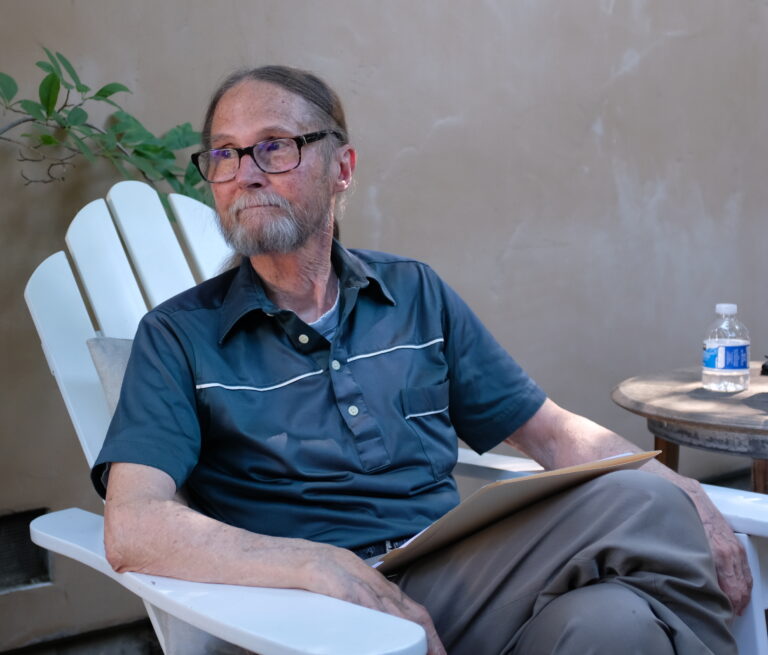
Richard Anderson left us two weeks ago today.
Several years ago, I was reporting on homelessness in Modesto when Richard Anderson asked whether I’d be willing to take him to a homeless camp. I told him they were pretty rough places. Richard said he was used to rough places, but I doubted him. He looked frail. He had been diagnosed with Stage IV lung cancer several years prior and had had a lung removed.
At the time, there was a camp on south Ninth Street where I knew most of the residents. I figured it would be safe enough.
Richard showed up with a camera and tripod. He was wearing loose fitting sandals. I worried about him falling. We had to walk over railroad tracks and wickedly sharp stones to get into the camp. Richard looked unsteady.
I shouldn’t have worried. Richard’s body seemed to operate as a function of his will, which even gravity couldn’t bring down — at least not then. Richard teetered, but he didn’t fall.
Film was just one of many of Richard’s passions. He was intent on recording local history. He captured volumes. He filmed over 250 videos with a local focus. He was the driving force for the documentary films Homeless in Modesto I and II.

Richard was also a pathfinder, but not in the usual sense. Richard found paths for others. That was his great gift. He led us into the light he shone forward toward achieving humanity.
With a PhD in Plant Cell Biology, Richard’s command of science was broad and detailed; he was a practicing ecologist and one of earth’s most steadfast advocates. Richard’s wife, Lynn Hansen, pioneered science instruction at Modesto Junior College by becoming the school’s first female Professor of Science.
An accomplished poet, Lynn partnered with Richard to promote the arts, the learning, and the values that direct our ongoing mission for a better community. She continues his project of inspiration, ennobling us with her presence as Richard did, with his constant practice of virtue and benign sacrifice, so long and so strong.
Four years ago, we published Tom Portwood’s profile of Richard Anderson. We’ve brought it back below, in memoriam.
Dr. Richard Anderson’s Life Lessons in Citizenship
By Tom Portwood — One of the Valley’s great community leaders, Dr. Richard Anderson took an often-adventurous path in life prior to arriving as a Professor of Microbiology at Modesto Junior College in 1989. Along the way, he experienced things that helped to shape the dedicated and caring activist he is today.
Not surprisingly, he has always worked fiercely as an advocate for a wide array of worthy causes — from fighting for social justice in the Santa Barbara of the late sixties and early seventies to teaming with others on the Modesto Homeless Documentary Project — and continues to do so well into his retirement years.
Early on, Dr. Anderson learned the value of looking for lessons in every situation.
“I was born in Des Moines Iowa, in 1944, but we moved to California when I was four, so I am basically a Californian,” Dr. Anderson recently recounted.
“We went to a literalist Christian church. Attending that church has been a problem for me as well as a blessing. But I did learn good lessons from that experience — that we should love others as we love ourselves and that we have a responsibility to make this world a good place.”

From an early age, Richard was fascinated by science, and enrolled at the University of Southern California with the intent of becoming a medical missionary. Upon graduation, though, he was still searching for what he wanted to do with his life.
Staying on at USC for graduate studies, he,
“Analyzed the feeding habits of fish, Lanternfish, in particular. Every day these fish migrate 300 meters down into the dark because they have to escape predators, and at nighttime they all come up again and start feeding on the plankton that’s been growing during the day. By studying these fish I was able to earn a Master’s degree.”
His intensive postgraduate studies next took him to the campus of the University of California at Santa Barbara, where he pursued his Ph.D. by using an electron microscope to study how plants move sugars from leaf to root.
“But something else happened at UCSB in those years,” he pointed out. “The Revolutions of the Sixties were happening — the Environmental Revolution, the Black Revolution, the Brown Revolution, the Women’s Revolution, and the gay people were beginning to come out. It was an exciting time.”
It was during this time that Richard became more of a progressive, someone willing to stand up for social justice.
‘I completed my doctoral exams early in 1970,” Dr. Anderson continued. “But I had no job. So I bought a restaurant for about $1,500. I learned another lesson — which is that running a small restaurant is really, really hard work, and takes up all your time seven days a week all day.”
In a sense, Richard had two separate restaurants.
“I had a gay coffee house which was open later at night. We served pie, ice cream, tea, and coffee. But we also had a restaurant open in the evenings, to serve food – brown rice with vegetables, and salad – you could get that for 99 cents. The specials were $1.10. The food was very simple, such as beef Stroganoff made with ground beef. I did that for a year. It was common for the food take to be all of $30 to $35 a night!”
The next turn in the career path took Dr. Anderson to La Mesa, California, where he taught full-time for a year at Grossmont College. Eventually, though, due to budget cuts and policy changes, he worked on a part-time basis for a few years before losing his position to a young woman.
“The school did the right thing,” he generously recalled. “This was the era of the Women’s Revolution. They needed to have youth, and they needed to have a woman!”
Undaunted by the loss of a job, and “excited by an opportunity to go to Belize with seven people to live there, and grow food,” he set out on his next great adventure — living off the land, far away from the United States and its consumer society.
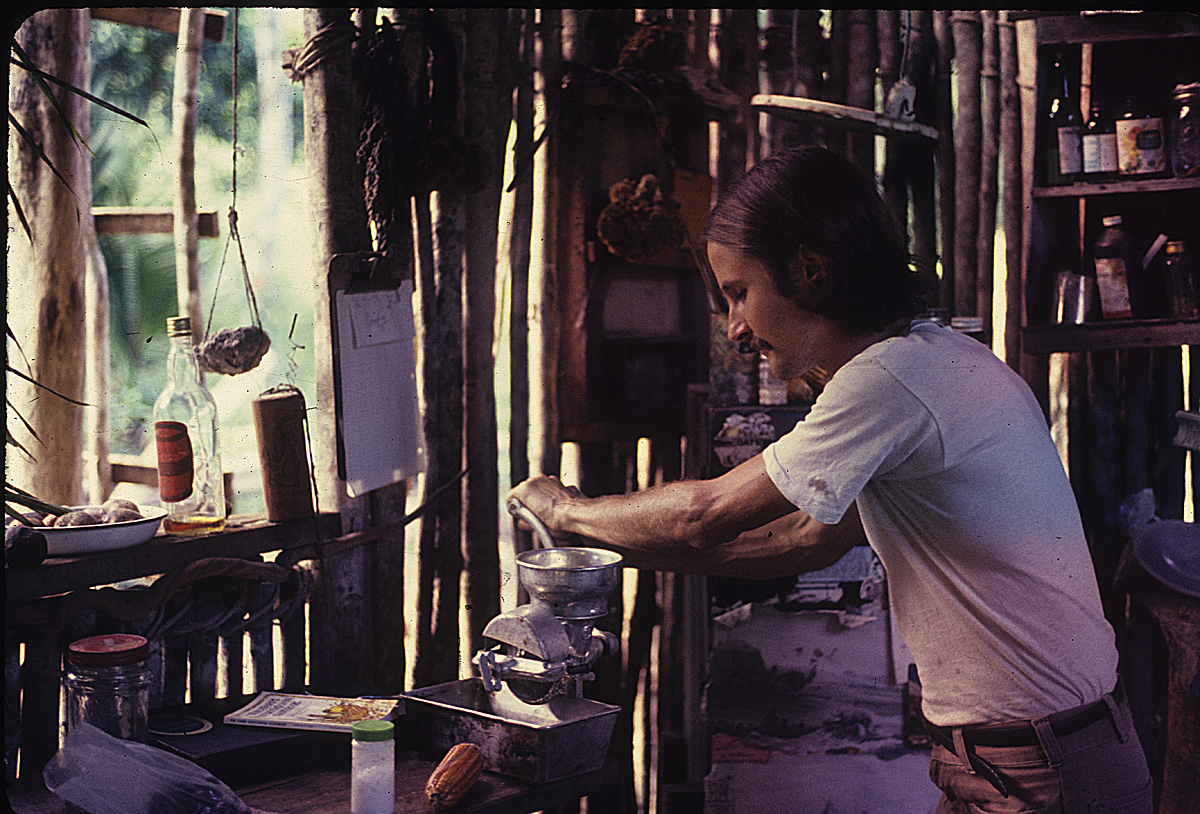
“The atmosphere in Belize was completely relaxed,” he related. He loved the country and its people but found, “I learned that not only was I not strong enough to make it on my own, but I really learned an appreciation for water. If you don’t have water, you don’t have life. I owned a Mayan-dug well maybe a thousand feet away down a gentle slope on the property where I lived, so I’d go down there with a yoke and two buckets and trudge back up that hill with the water. So this notion of turning on a tap for water and wasting it when we forget to turn it off – no, that experience made me into a water conservation fanatic. I learned many others lessons, too, including that I could not live in a non-technological society. I came back to the States to start up a new life.”
Landing back in California in 1980, Dr. Anderson studied for a time to become a nurse, pursuing an LVN degree at Columbia College, but eventually started teaching at the school since, with his Ph.D., “I could teach any biology class they wanted to assign to me.”
In the late 1980s, he returned to school to learn microbiology at UC Davis.
“That really enhanced my life, because now I could teach a broad range of subjects – microbiology, anatomy, physiology, and general biology. In 1989, I was hired at MJC, which was even better because I specialized in microbiology. I was able to make a film about the germ theory of disease on a sabbatical leave,” he mused. “In addition to getting the job, a couple of years later I married one of the biologists on the committee who had hired me – Lynn Hansen,” he added chuckling. “That really changed everything for me!”
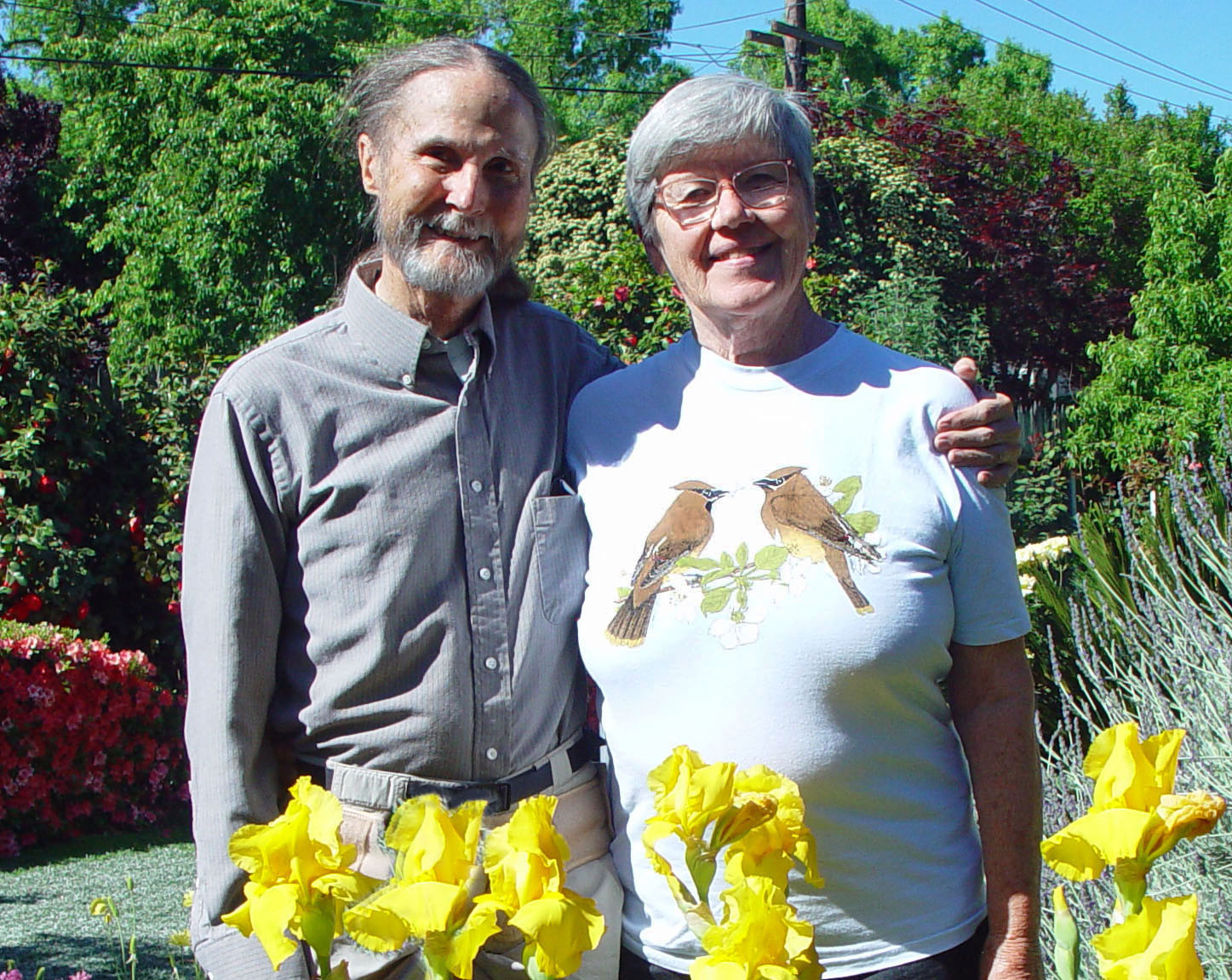
In the ensuing thirty years, Richard and his wife Lynn have traveled extensively, including to such far-flung destinations as the Galapagos Islands, the Antarctic, Tanzania, and Midway Island.
Following his retirement from MJC in 2009, Dr. Anderson redoubled his efforts in the community where he had taught and made a home with Ms. Hansen. This led to The Modesto Homeless Documentary Project.
“I spent most of my life in the Ivory Tower of academia so I felt the need to try to learn what’s going on outside,” he explained.
“There is such a homeless problem here. I hooked up with Frank Ploof, Leng Power, John Lucas, and Eric Caine, and we made a documentary on the homeless in Modesto up until 2018.” It’s at: https://youtu.be/PHauVTGXQsE
“It’s sort of a historical document because in the fall of 2018, the 9th Circuit Court of Appeals passed a ruling on the Boise case that says you cannot cite people for camping in public unless there is enough sheltering available in that community. There are no metropolitan communities that have enough sheltering, and so that ruling caused the big changes that we’ve seen in Modesto. We are now making a new movie that updates our area’s responses to the issue over the last few years. What our area has done in response is really quite complex. I know we’re not doing enough. More people are being added to the ranks of the homeless every year by all these powerful economic forces. I also want to complete my other video, which is called Here and Now: Local Climate Change Impacts.”
Dr. Anderson contributes impressively in other ways as well. With his video equipment in hand, he’s documented a plethora of local events, including poetry readings, candidate forums, and political rallies and marches. He’s interviewed numerous religious leaders and scientists and documented their thoughts on video.
He’s been a member of the League of Women Voters for many years, and has long served as a volunteer for the Modesto Peace & Life Center. Recently, he and Ms. Hansen have been helping a family from Syria get established here in Modesto.
“I’ve learned a lot about Modesto and the Valley since I’ve been here, and met many wonderful people,” he reflected when asked about the Valley. “Yes, we have our problems. But this is a very kind group of people that I know and with whom I work. It’s a welcoming place, in a way. Of course, a lot of it is having met Lynn, and married her, and becoming integrated into the community. That has really opened my eyes to all kinds of wonderful people. I’m just trying to help build that community that we all want to live in.”
RIP Richard: So long and so strong.
If the world makes many souls like Richard Anderson: Humble, kind, generous & loving, yet with the sharpest of minds and the thirst to transmit all of those traits to any willing to learn – I’ve only had the good fortune to encounter a very few.
His work made the world, and many of the people he met through his various work and projects, better for his being.
With deep condolences to his family and his many friends, Rest in Peace and Harmony, Richard.
My heart is deeply broken as I try to find the words to honor Richard—a man who was truly one of a kind. He carried within him a rare and beautiful balance: a heart so tender, compassionate, and full of empathy, yet a spirit that was steady, strong, and unwavering. He had a way of making people feel seen, understood, and cared for, and that is a gift not many possess.
Richard’s kindness wasn’t loud or showy—it was quiet, genuine, and deeply felt. It lived in the way he listened, the way he showed up, and the way he gave of himself so freely to others. His presence brought comfort, warmth, and a sense of peace to those around him. To know him was to experience true friendship.
I feel incredibly grateful and blessed to have called him my friend. The memories we shared, the laughter, the conversations, and the simple moments will stay with me always. His absence leaves a space that can never truly be filled, but his spirit will continue to live on in the lives he touched so deeply.
May his memory forever be a blessing, a source of light and love that continues to guide and inspire.
Rest in peace, my dear friend. You will be missed more than words can ever express, and you will never be forgotten.
I met Richard through the Modesto Institute for Continued Learning (MICL), where I also met his wife Lynn. What a couple! Great minds, compassionate souls. I recall that I once teased Richard about his long hair, calling him a hippie. I’m not sure if I noticed the sandals at that time. That was before I learned about his adventures in Belize and Santa Barbara. He WAS a hippie, living off the land, creating community, respecting every living soul. I send heartfelt condolences to Lynn.
Thank you for this tribute to Richard Anderson. He and his wife, Lynn, have been good friends of ours for years. Richard was a compassionate soul, one who attempted to help us reach our better angels. He left his mark on this planet and he will be missed.
When I think of Jesus, I picture Richard Anderson.
I lived with Richard from the late 70s to 1982, and I’ve never encountered anyone with as much curiosity about all aspects of our world and universe. It was a delight to speak with him for hours on all kinds of topics, since he knew a lot about a lot of things. His generosity to me and others was boundless. He is, simply put, one of the most remarkable human beings I’ve been blessed to spend some serious time with. I will miss him deeply for the rest of my life.
Love Richard ♡
Great man!
Dr. Richard Anderson’s legacy will live on! I am grateful that I got to know him through his friendship with my husband. He was indeed a giant of a man, yet so humble. My deepest condolences to Lynn and all who will miss him dearly.
Richard lived the life we are all supposed to live here on planet earth…to love self and the other…to live a good life. He will remain in our hearts and his life will continue to inspire us to be the best we can be and work to make the world a better place.
Comments are closed.