
“No man is allowed to be a judge in his own cause, because his interest would certainly bias his judgment, and, not improbably, corrupt his integrity.” James Madison
Virtually no one disputes the fundamental conflict of interest principle expressed by James Madison in the Federalist Number Ten. In fact, Madison himself derived the principle from ancient Roman law, where it’s expressed in Latin as, “Nemo judex in causa sua.”
Nonetheless, despite the obvious truth of the ancient Roman maxim, the Modesto Irrigation District (MID) ended an investigation into the irrigation practices of a member of its Board of Directors when that same member voted in his own interest last December 16.
Larry Byrd’s conflict of interest when he voted to end the 4Creeks’ investigation into water use on the AB La Grange ranch was obvious and got widespread publicity. Less obvious were the other conflicts.
It seemed entirely aboveboard when Director John Boer recused himself before the December 16 vote. After all, Boer works for Byrd’s brother Tim, who is a partner in the AB La Grange Ranch. Nonetheless, by any measure, Boer had no personal financial interest at issue.
In fact, the only possible financial interest — or liability — Boer could possibly have in the investigation would be if he were to suffer adverse consequences from his employer — Byrd’s brother and partner — if he were to vote to continue the investigation. On the other hand, a vote to end the investigation could be construed as an attempt to curry favor with his boss, so Boer recused.
The problem here is that Boer’s recusal amounted to a “no” vote in any case. Based on questions raised by the investigation itself and the failure to determine the water source for Byrd’s out-of-district trees, Directors Robert Frobose and Chris Ott voted to continue the investigation. Ott said that failure to continue would, “look like a cover-up.”
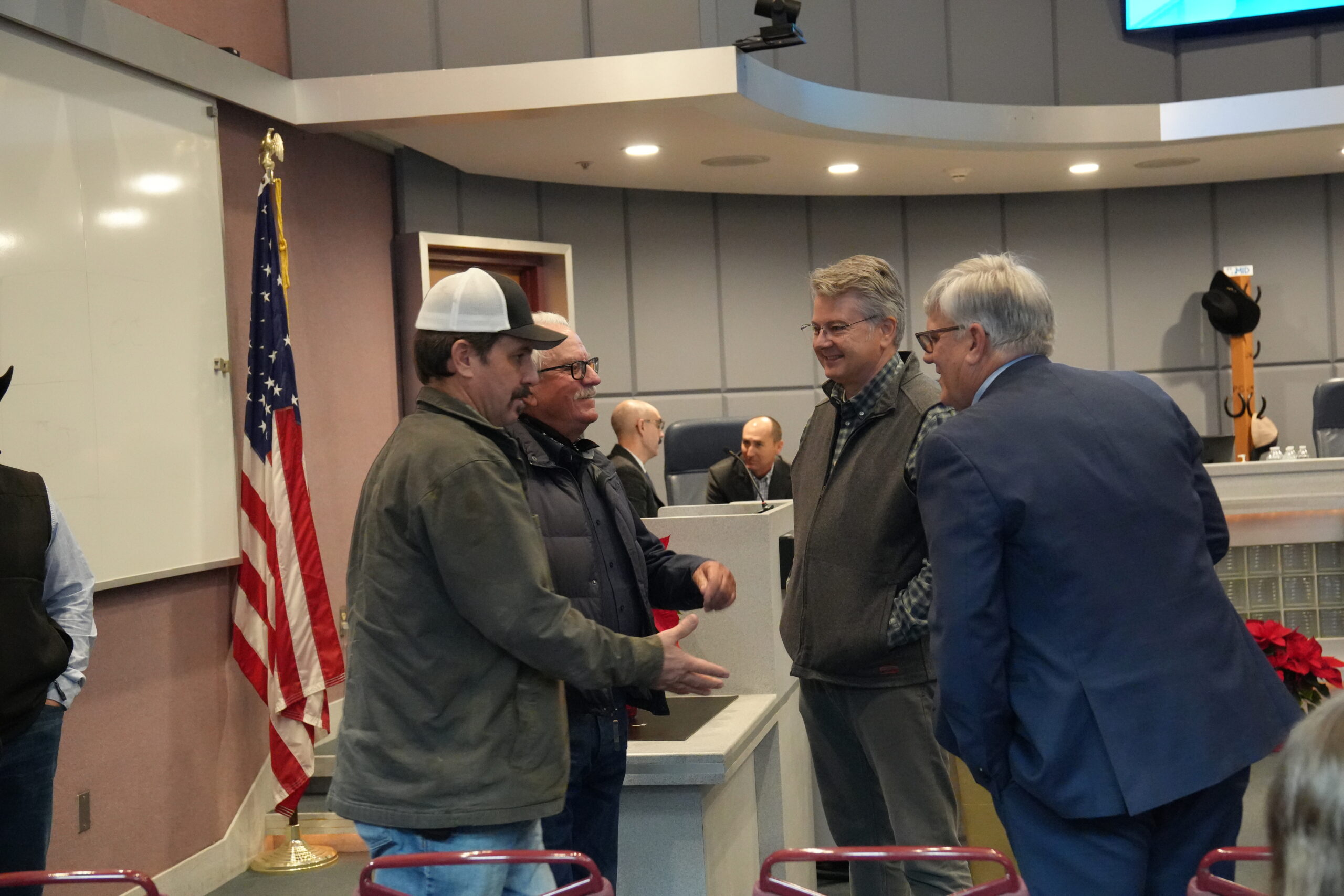
When Janice Keating joined Larry Byrd in voting to end the investigation, Boer’s recusal amounted to another “no” vote because his abstention resulted in an end to the investigation. It deprived District ratepayers and the public in general of further investigation into Byrd’s alleged misuse of the District’s most valuable asset — water — which is monitored and managed by MID in service to the public trust.
Moreover, if Boer’s supposed “conflict” is due to possible adverse consequences should his vote displease his employer, how does that same issue affect MID management and counsel?
Larry Byrd was the prime mover in the termination of Ronda Lucas, MID’s water attorney, in 2025. Given his close relationship with John Boer via Byrd’s brother, Byrd can conceivably command two Board votes at any given time. Boardmember Janice Keating has sided with Byrd in recent votes; it would make sense to see Byrd’s influence on MID staff and management as conflicting a factor as his brother’s influence on John Boer. Byrd is, in a very real sense, a “boss,” or, “employer.”
In fact, one of the more puzzling questions during the nine-month long inquiry into the source of water for Byrd’s out-of-district trees — over 140 acres — is why MID hasn’t been able to provide conclusive evidence one way or the other by way of billing and pumping records. It would seem as though staff and management have ceded both authority and responsibility in much the same way as John Boer has, and perhaps for the same reasons, especially since such records could have cleared the issue months ago.
In any case, a reasonable inference here is that conflicts of interest at the Modesto Irrigation District have resulted in an abuse of the public trust. The only corrective is intervention by higher authorities, including a full-scale audit by a disinterested and qualified third party.
Thank you for keeping the pressure on this local fiasco.
It is interesting that there appears to be no oversight on issues that happen in the MID board room.
Larry Byrd is hiding his guilt & this investigation needs to be elevated & carried out to either exonerate Byrd or to prosecute him & lock him up!!! This guy is dirty as Hell.
Thank you to the two board members that voted to continue the investigation. They are true patriots 🇺🇸
An organization plagued with corruption. Imagine all the parties involved. The GM had no other choice but to produce a non-conclusive investigation from the consultant to protect his job. The consultant is hired to produce what they are asked to produce, a rigged investigation. The Public Affairs person promptly telling the Bee that Byrd was legally allowed to vote on his continued investigation. You expect us to believe that the Irrigation Manager and Ditchtenders didn’t know or don’t know whether he is pulling water? The corrupt keep secrets. Wasn’t it Byrd that appointed the GM, with help from Blom and Boer? Let’s face it, Boer, the GM, the consultant, Public Affairs, irrigation workers, in the pocket of Byrd. Must be nice to have that much pull. If I were one of Boer’s constituents, I’d be upset! They voted for you to protect their interests, not to protect yours. Where is the Civil Grand Jury or the FPCC? Keep on pressing the issue Mr. Caine! Another scandal in the valley, much like StanCOG. The question is, how deep does the corruption go?
Grand Jury – methinks they are ahead of you already … PIO takes direction from GM and synopsizes Board Meeting. MID has one of the BEST. Would you want her job? Methinks NOT! ABSOLUTE PROFESSIONAL! Yes – you need to hear from the ditch tenders but a lot of them have retired and are unavailable. Like Boer or not, word is he consulted the General Counsel and followed that advice. That’s what those lawyers (and GM) are there for – protect the Board – not take sides. Not hard to defend legally. I have more of a problem with abstentions. Eyeson209 OUT.
I think it’s important to separate frustration from facts here. Strong claims about corruption deserve equally strong evidence, and right now a lot of what’s being said sounds more like assumption than proof.
For one, Boer has consistently shown that he listens to his constituents and votes accordingly. Public records reflect that he has actually voted against Larry Byrd more often than with him, which doesn’t support the idea that he’s “in anyone’s pocket.” Boer didn’t support the lower-cost water proposal that Larry brought forward. He has also taken positions that directly push back—such as opposing electrical rate increases to protect the people he represents. He’s also continued to engage with constituents and have open conversations about issues within MID, which is exactly what accountability looks like.
It’s also misleading to suggest Boer works for Larry Byrd. His primary job is running his family farm. Like many in agriculture, he does custom farming for multiple clients, including Tim Byrd, but that’s a business relationship—not political control. As for the recusal from voting, per FPPC “business entity“ disqualifying financial interests rules, Boer followed the guidelines of the FPPC. There is no difference than past president Mensinger recusing himself on every vote to pay bills due to his business interests.
More broadly, Boer has built a reputation on putting the community first. That often means setting aside personal opinions and focusing on what benefits his constituents as a whole. You don’t have to agree with every decision he makes, but it’s a stretch to turn that into a narrative of coordinated corruption without clear evidence.
If there are real concerns, they should absolutely be investigated through the proper channels—but accusations alone shouldn’t replace facts.
No one has suggested here that John Boer works for Larry Byrd. Rather, Boer works for Tim Byrd, Larry Byrd’s brother and partner in the AB La Grange Ranch. There are real concerns and investigation “through the proper channels” has been blocked with Byrd’s own vote. Those are demonstrable facts. It is also a fact that Boer claimed a conflict when recusing. What exactly is that confiict? If not financial, what FPPC guideline is involved in Boer’s recusal?
Mr. Waters,
Your argument fails when you advocate for facts while defending someone who refused to simply support further investigation to determine those missing facts. The vote John Boer recused was not in any way an indictment, but merely in favor of gathering all the facts needed to complete a thorough and complete investigation, as Robert Frobose repeatedly explained.
Please recall that Frobose was only proposing that, due to the 4Creeks finding that Byrd could not have irrigated out-of-district trees solely with groundwater, further investigation is required to determine the source of that water which, if MID surface water, is worth hundreds of thousands of dollars.
Boer’s decision that voting merely to continue to seek the truth by additional investigation on such a serious allegation would appear to be a conflict-of-interest seems to assume that the missing facts couldn’t possibly exonerate Director Byrd, thus, a supposed conflict. Viewed another way, Boer’s support of further investigation could have met your requirement that “Strong claims about corruption deserve equally strong evidence,…”
I don’t know Director Boer, maybe he just didn’t think this vote through all the way. One way he could remedy this is to call for a vote on another motion for further investigation without assuming the outcome, if truth is what we’re really after here.
Perhaps you have a better solution?
I think it’s important to separate frustration from facts here. Strong claims about corruption deserve equally strong evidence, and right now a lot of what’s being said sounds more like assumption than proof.
For one, Boer has consistently shown that he listens to his constituents and votes accordingly. Public records reflect that he has actually voted against Larry Byrd more often than with him, which doesn’t support the idea that he’s “in anyone’s pocket.” Boer didn’t support the lower-cost water proposal that Larry brought forward. He has also taken positions that directly push back—such as opposing electrical rate increases to protect the people he represents. He’s also continued to engage with constituents and have open conversations about issues within MID, which is exactly what accountability looks like.
It’s also misleading to suggest Boer works for Larry Byrd. His primary job is running his family farm. Like many in agriculture, he does custom farming for multiple clients, including Tim Byrd, but that’s a business relationship—not political control. As for the recusal from voting, per FPPC “business entity“ disqualifying financial interests rules, Boer followed the guidelines of the FPPC. There is no difference than past president Mensinger recusing himself on every vote to pay bills due to his business interests.
More broadly, Boer has built a reputation on putting the community first. That often means setting aside personal opinions and focusing on what benefits his constituents as a whole. You don’t have to agree with every decision he makes, but it’s a stretch to turn that into a narrative of coordinated corruption without clear evidence.
If there are real concerns, they should absolutely be investigated through the proper channels—but accusations alone shouldn’t replace facts.
Well Brandon, sounds like you are in agreement that there is no conflict of interest and Mr. Boer should have voted. Because I did not see the conflict either when he recused himself. So, essentially that saved his job with Tim Byrd by recusing himself which means he was a “no” vote to a continued investigation, and a “ yes” vote to saving his custom farming job with the brother of the accused. Larry Byrd may not have bought a board member but sure looks like Tim Byrd did.
I’m sure Mr. Boer is a nice guy just maybe not board member material.
Eric thanks for keeping on and thank you to the other two board members Mr. Ott and Mr. Frobose for looking out for the rate payers!
Comments are closed.