
Members of the lay public who tried to trudge through the blizzard of drifting snow that covered critical details of the 4Creeks’ investigation into Larry Byrd’s irrigation of over five-hundred acres of almond trees on the AB La Grange Ranch would be entirely justified for calling the investigation a “cover-up.”
Actually, the investigation is a treasure trove of incriminating data; problem is, 4Creeks never connected the dots.
Larry Byrd sits on the Board of Directors for Modesto Irrigation District (MID). He’s partners with his brother Tim and farm developer Ty Angle on properties formerly known as the “Rodoni” and “Rairden” ranches, just west of La Grange, an unincorporated community most famous these days for “Louie’s Place,” a bar and restaurant beloved by locals and frequented by tourists, bikers, and boaters. La Grange is near the southeastern corner of Stanislaus County.
Byrd’s irrigation sources became a public issue last July, when a former member of the Oakdale Irrigation District Board of Directors said he had almond trees outside MID boundaries. Byrd had previously led people to believe all his trees were within the district.
Asked about the out-of-district trees, Byrd claimed he irrigated them with water from “deep wells.” When a former ranch foreman said that the diesel pump for the well in question was “seldom” used, MID Board Members decided to investigate. The foreman’s claims were corroborated by a co-worker and seven years’ meticulous journal records, including pumping routines. MID hired 4Creeks, an engineering firm specializing in design and construction, to conduct the investigation.
After several months, the investigation raised more questions than it answered. However, 4Creeks’ investigators did corroborate claims that Byrd had not irrigated his out-of-district trees with groundwater. The exact wording from 4Creeks’ investigation reads as follows:
“….the cumulative water balance assessment demonstrates that available groundwater was insufficient to satisfy crop irrigation requirements for the Out-MID unit across the combined four-year period. Both the upper and lower estimates indicate substantial groundwater deficits, ranging from approximately 0.65 acre-feet per acre to 3.98 acre-feet per acre annually. These deficits indicate that groundwater alone could not have met the full irrigation demands of crops cultivated within the Out-MID study unit during the analysis period…”

Once it had been established that Byrd hadn’t used groundwater, the only issues pertinent to MID stakeholders were how much water Byrd paid for and whether it was enough to meet irrigation requirements for the total almond acreage farmed on the AB La Grange Ranch. 4Creeks did not address those questions.
First, MID ratepayers — power and water users and in-district farmers — still need to know how much water Byrd has been billed for. Second, they need to know whether the amount he was billed for in acre-feet was greater than, equal to, or less than the irrigation water requirement for the total almond acreage on the AB La Grange Ranch.
The answer to the second question might necessarily involve further inquiry. For example, if the billed amount equaled the amount of water required for the in-district trees, there would then be the need to know how much MID surface water was delivered to out-of-district trees free of charge. Absent groundwater, there was no other source than MID surface water.
If the amount billed was greater than the amount needed for the in-district trees, the clear indication would be that Byrd used the water out-of-district. The question then becomes, “How much water?” That question can be answered by referring to the “Irrigation Water Requirement” (IWR) established by the 4Creeks’ investigation and similar figures widely available throughout the state.
There’s another possibility, by far the most disturbing. Suppose that Byrd did not use groundwater but was billed for less than the amount of water needed for his total acreage? If the billing figures showed Byrd was billed for less water than the IWR, the reasonable inference could only be that MID has a severe accounting problem. Surface water is a public resource and MID’s greatest asset.
And, in fact, MID pumping records show that Byrd did not use enough water for his total acreage. According to 4Creeks, and based on common knowledge among farmers, the IWR for an almond crop in the northern San Joaquin Valley is approximately forty inches. The rule-of-thumb for most Valley farmers is forty-two inches, or three-and-a-half feet.
The 4Creeks’ study included four-hundred and thirty-six acres. Three-hundred and forty acres are within MID boundaries. Ninety-six acres are outside. The study period included years from 2020 through 2024. 2022 was a dry year, and thus offers a particularly illuminating example based on reported water use on the AB La Grange Ranch.
The MID allotment for 2022 was thirty inches, or two-and-a-half feet. According to 4Creeks, MID deliveries to the AB La Grange Ranch amounted to just over forty inches (40.37; Table 8). That’s a little over three-and-a-third acre-feet (3.36). Byrd has explained he was able to go over the MID allotment by balancing water allotments with a master water plan or general water account (more about that later).
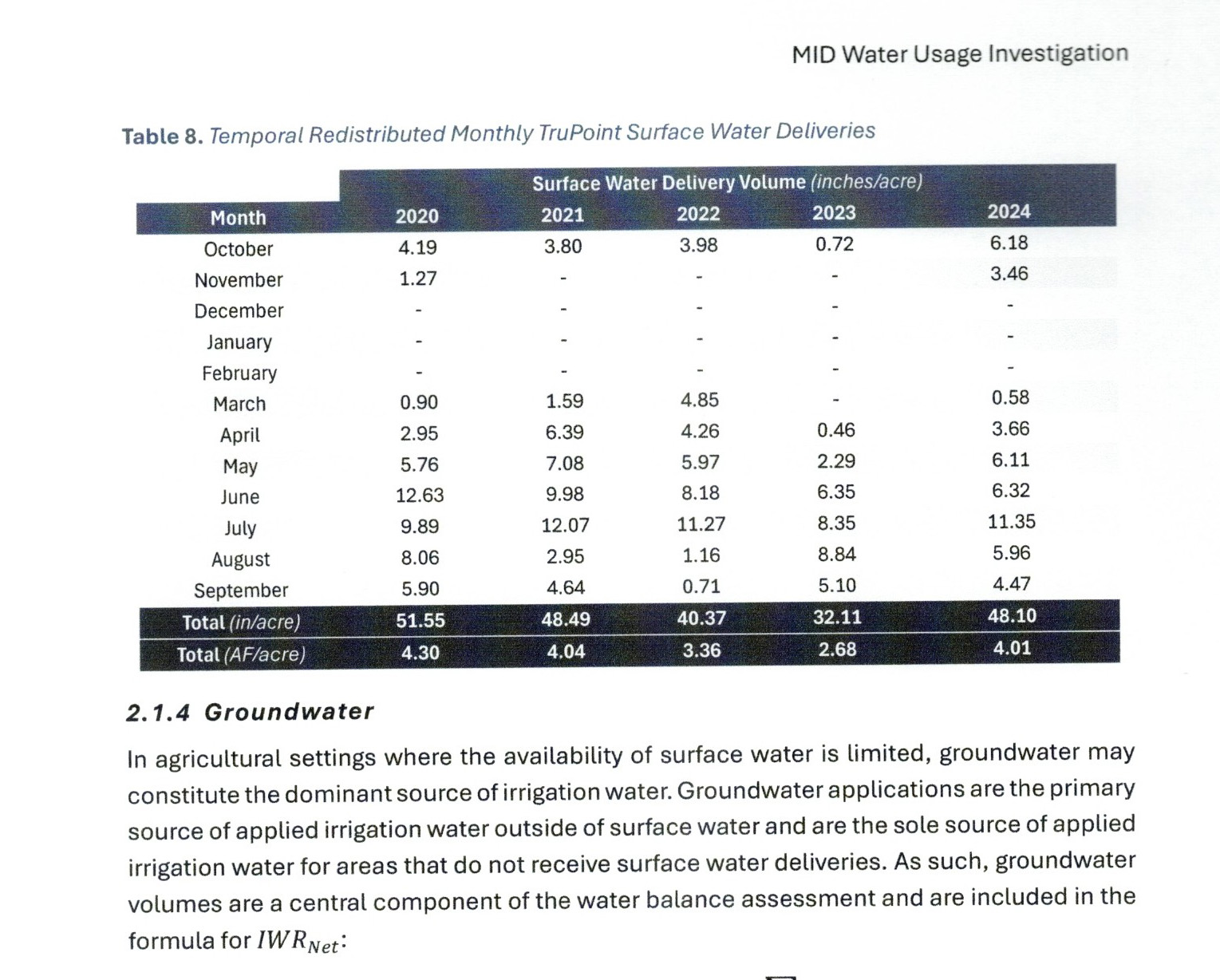
Multiply 40.37 times 340 and divide by 12. The answer, in acre-feet, is just under eleven-hundred and forty-four (1143.81). Now, multiply 40.37 times 436. The answer is just under 1467 acre-feet (1466.77). That’s over three-hundred acre-feet of unaccounted for water — the water needed for the ninety-six acres (96 x 40.37 divided by 12 = 322.96 acre-feet). Today’s price for out-of-district MID water is two-hundred dollars an acre-foot.
Do the math. According to 4Creeks’ data, based on information supplied by MID, Byrd’s AB La Grange Ranch did not receive enough water to meet the IWR for his total acreage of thriving almond trees.
It gets worse.
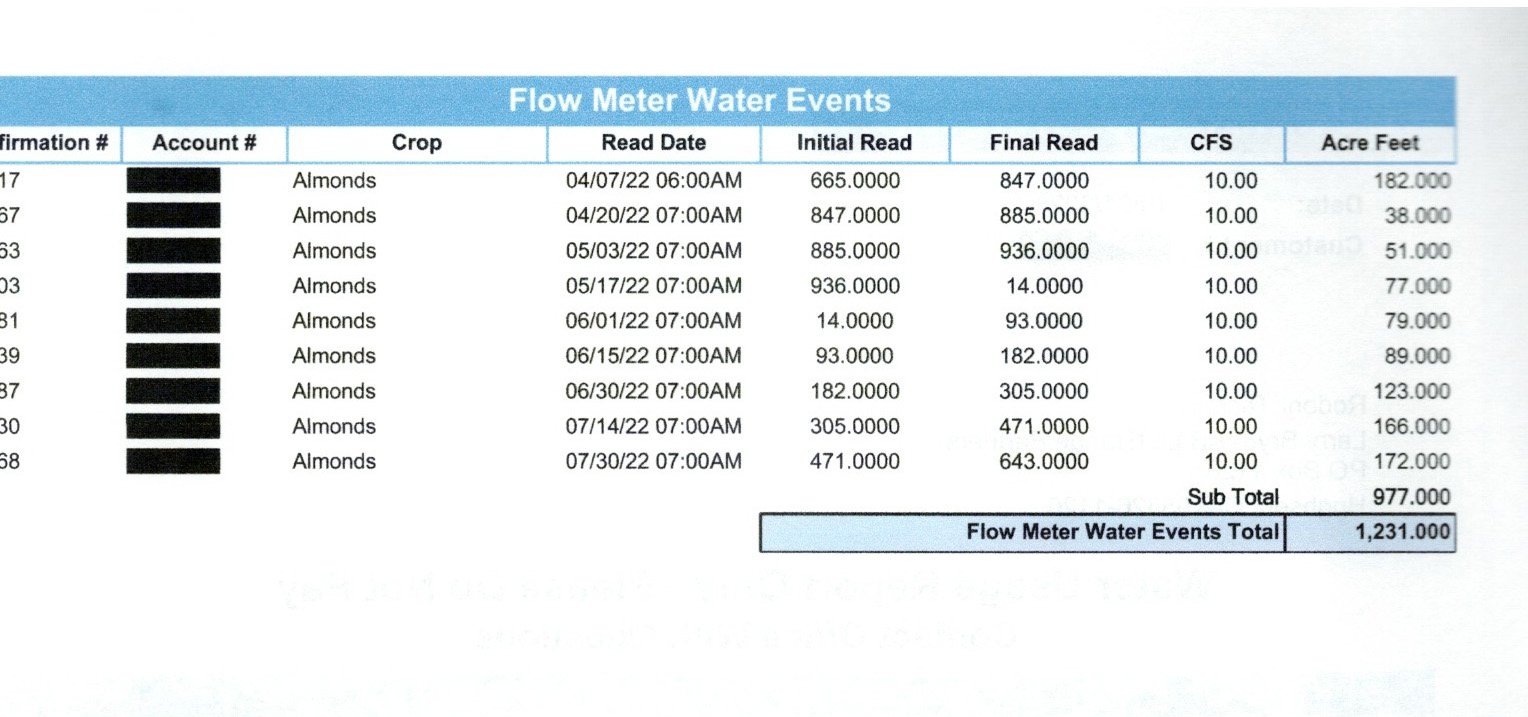
When I asked for the actual billing records for MID surface water on the Rodoni property’s three-hundred forty acres on the AB La Grange Ranch, MID sent a report saying Byrd used nine-hundred seventy-seven acre-feet. That figure is significantly short of the acre-feet reported by 4Creeks.
Another interesting thing about that report is that it’s much closer to the thirty-inch MID allotment for 2022 than the almost eleven-hundred forty-four (1143.81) reported by 4Creeks. In acre-feet, the thirty-inch allotment for three-hundred forty acres comes to eight-hundred fifty acre-feet, just below the nine-hundred seventy-seven acre-feet in the MID report.
Disregarding the discrepancies — just for the moment — between 4Creeks’ figures (1143.81 acre-feet) and MID’s numbers (977 acre-feet) none of these figures meets the IWR for Byrd’s four-hundred thirty-six acres of almond trees.
It gets worse.
In addition to the four-hundred thirty-six acres Byrd and his partners irrigate on the Rodoni property, there are another seventy-two acres on the Rairden property. Forty-two of those acres are outside MID boundaries; thirty are within. Though MID Board Chair Robert Frobose specified the Rairden property be included in the 4Creeks’ investigation, it was omitted. When I requested pumping records for the Rairden property, they came heavily redacted.
With regard to the redacted records, it is almost certain that Larry Byrd and his partners are invoking privacy rights to avoid having to release details about their “Master Water Plan,” pumping records for the Rairden property, and other details pertinent to water use on the AB La Grange Ranch. After all, if those records were exculpatory, Byrd and MID would be trumpeting them as headline news.
Despite Byrd’s putative privacy rights, however, the fact remains he is an elected official sitting on the board of a public utility. Furthermore, there is case law (New York Times vs Goleta Water District) regarding the release of information when customers of a public utility exceed their water allotments; in that case, the court concluded that the public interest outweighs privacy rights in cases involving private abuse of public water allocations.
In total, Larry Byrd and his partners irrigate 138 acres of out-of-district almond trees on the AB La Grange Ranch. The aforementioned price for out-of-district MID water is two-hundred dollars an acre-foot. Do the math.
Based on numbers released so far, the Modesto Irrigation District isn’t getting paid for a significant proportion of the District’s most precious asset. That asset is one of the chief resources in the general public interest.
In short, the public has a right to know why MID has released conflicting accounts of water usage on the AB La Grange Ranch and how much water Larry Byrd and his partners actually paid for. At this point, the released records don’t match and none of the released figures meet the Irrigation Water Requirements established by the 4Creeks’ investigation.
It’s time for the truth to come out.
Eric, there seems to be no place or organization to bring accountability to this MID issue. MID general counsel should be all over this considering what they state in their code of conduct but I do not imagine that will ever happen. Why is MID not wanting to get to the bottom of this issue and make a determination if Director Byrd is innocent or guilty. This is certainly a black eye for MID showing that it is afraid of accountability and just a “good old boys club”.
Agreed John. MID has nurtured a culture of corruption that goes all the way to the top.
“MID showing that it is afraid of accountability and just a “good old boys club”.”
“TEAM LARRY” connotes “good old boys club.” It is another way of saying, “you scratch my back, I scratch your back.”
“TEAM LARRY” prioritizes Larry Byrd over the MID ratepayers’ best interest when their interests diverge. Byrd’s proposed $60 per acre foot sale to out of district growers on the east side of Stanislaus County is a prime example.
But it’s the GM, General Counsel, Larry Byrd, Janice Keating and John Boer who failed to muster accountability. Do right by the ratepayers first and foremost, always. Honor your oath.
WRITE/right on!!
We the people are sick and tired of the audacious, selfish and bold nerve of the takers who keep rationalizing their greedy and dishonest behaviors and sticking it to the hard working honest people of our society.
Thanks for bringing us up on the need for honest accountability from MID and the like!
The David Valadao political machine is cranking out ads that look like they are a reminder to the local Ag culture how good for them Valadao has been. At one point in the ad the voiceover claims that Valadao is a champion at bringing water to the Valley “where it belongs.”
I’m no expert on water politics, but that does seem to be the mindset for much of Valley Big Ag: The water is ours. It belongs here. We should get as much as we need, and this should never be questioned.
It borders on a religious maxim, with an almost cultish following. After all, the way the proposition is organized in their brains begins with a romantic notion that “We feed America,” which provides moral cover for any seedy tactics they engage in. And because the water flows from the foothills and has always kinda been here anyway, it takes on a birthright feel. It’s not the water. It’s *our* water.
It’s hard to adjust people’s thinking or change behavior when the fundamentals are so deeply imprinted in human DNA. It isn’t hard to imagine a slightly dystopian future where the Valley landscape is dotted with water militias.
Nice work Eric, staying on top of this stuff. It’s blessed work.
Perceptive analysis, JT. Yes, the foothills water miners do indeed believe they have a God-given right to the water, even when it’s for an export product. And once they’ve taken all the water out from under us, they want to get back to taking all the water out of our rivers. Remember, only a short while ago, the mighty San Joquin River dried up for a sixty-mile stretch every summer, due to overuse by the Valley’s “food” export industry. Only after almost twenty years’ litigation was enough water restored to keep the river flowing, and that has resulted in blowback in the form of accusations of “communism.” The principle that water belongs to the people in the form of the public interest doesn’t have much currency here in the Valley, where the only real currency is currency itself. The green stuff. Benjamins. Lots of Benjamins.
Larry Byrd was an employee of MID for many years. During that time, the ratepayers paid his salary and his health insurance for him and his family, and provided him a retirement plan. Byrd, in appreciation of all that the ratepayers have done for him, steals from them.